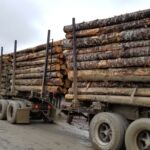
Traditional load securement methods require drivers to manually throw, cinch and tighten heavy wrappers which is a physically demanding task. Repetitive manual wrapping of log loads can lead to a high risk of musculoskeletal injuries (MSI) especially shoulder injuries, which is common among log truck drivers. Over the last five-year period, these MSI related injuries are resulting in claim cost of more than 2 million dollars in BC. Under occupational health and safety regulations, employers have an obligation to find and implement solutions that will reduce the risk of injuries to the workers. Therefore, automated load securement presents a key opportunity to reduce injuries, improve safety, maintain regulatory compliance and deliver operational efficiency.
| Exte Com90 | Unylaser RaptorSafe | Trinder WASP |
Proven Scandinavian system Testing utilized a Tridem tractor and Quad axle trailer with 2.6m wide bunks. |
Prototype Brazilian system to be piloted in early 2026. Testing will utilize a 9-axle B-train with 2.9m wide bunks. | Field proven New Zealand system to be fully tested in early 2026 following preliminary testing in 2025. Testing will be on an 8 axle B-Train with 2.9m wide bunks. |
| Com90 is a full automated load securement system: bunks with telescoping (retractable) stakes, lashing arms, hydraulic locking tensioning, and remote control or in cab controls. | RaptorSafe is similar in operation to the Com90 system, but it is expected to be lower in when cost compared. | Trinder WASP system combines three components: a wrapper thrower (pneumatic arm to automatically place the wrapper over the load), an auto tensioner (to tension the wrapper, maintain constant tension, reduce slippage) and a load monitoring senor (measures wrapper tension and alerts driver to faults both during loading and in transit). |
| Evaluation period covered 165 trips (~40,000 km, ~1000 engine hours) and ~6700 tonnes of logs transported, the system worked very well during the evaluation period and achieved on average ~18 minutes of time savings per trip compared to traditional manual wrapping thereby increasing efficiency. | Initial controlled test was conducted in 2025, which required some modification to accommodate 2.9 m loads. | The system is retrofittable to existing bunks which could reduce capital cost compared to replacing entire bunk assemblies. Stage 1 pilot trial in 2025 entailed testing the wrapper thrower on solid stakes.
|
| Evaluation Study Completed – Info Note 03 – June 2025. | Inservice trial of RaptorSafe system has not started yet. | Stage 1 evaluation of Trinder system is completed and published in Trinder report. |
| There is a plan to continue monitoring the performance of Com90 in operation. | Once the pilot of RaptorSafe is successful, then a six-bunk system will be installed for further testing. | Stage 2 will be evaluating the overall Trinder system including folding and fixed stakes, load tensioners and tension monitoring. |

Adopting automated systems such as Com90 in operation will eliminate manual load securement and injury risks, while also cutting load securement time per load. Automated systems still require mechanical maintenance and regular inspections. The driver and loader operators need to be trained on new procedures for the successful implementation of automated load securement system in operations. Post implementation, the safety and productivity metrics can be tracked to build a business case for broader fleet adoption.


Early findings of pilot studies in BC – especially with Exte Com90 and Trinder WASP show that automated load securement systems are not only feasible but also effective in reducing or eliminating injury risk, speeding up load securement, and satisfying regulatory requirements. A National level load securement working group under CCMTA is currently reviewing the study findings with intent of incorporating any updates into national safety code if required. With proper configuration, maintenance, training and oversight, these systems offer a safer and more efficient alternative to manual load securement techniques – and represent a real opportunity for the forestry sector to lower injury costs, improve driver safety, and increase operational efficiency.
Contact
Mithun Shetty, Senior Researcher FPInnovations mithun.shetty@fpinnovations.ca
Related post
https://web.fpinnovations.ca/collaborative-research-for-improved-safety-of-forestry-workers/