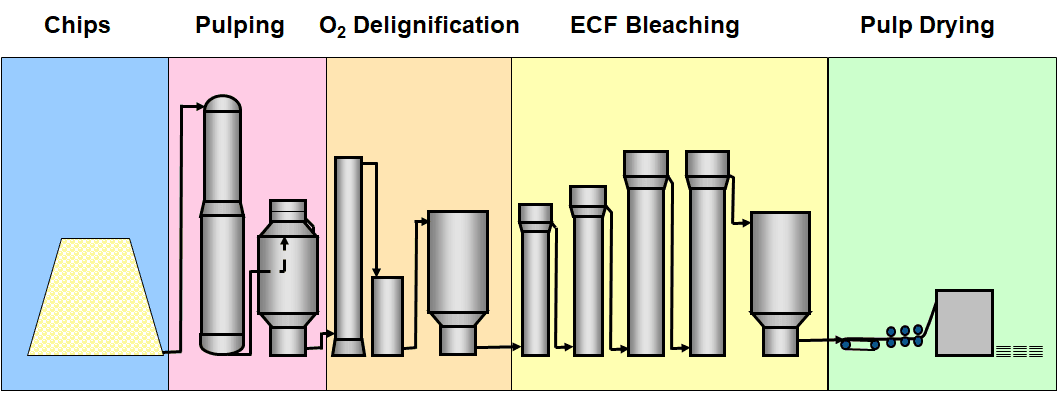
Schematic of a typical kraft fibreline with a single-stage oxygen delignification system
At kraft pulp mills, oxygen delignification is a unit operation between cooking (pulping) and the bleach plant. The primary goal of oxygen delignification is to reduce the lignin content (or kappa number) of the pulp before entering the bleach plant. Its importance lies in its ability to selectively remove 25 to 50% (single-stage) of the remaining lignin from “brownstock” pulp. A two-stage oxygen system can achieve 50 to 70% delignification efficiency depending on design and operating conditions. Since less lignin enters the bleach plant with the pulp, less chemicals are needed to bleach the pulp to the same brightness target. This leads to significant savings since oxygen is much less expensive than chlorine dioxide, hydrogen peroxide or sodium hydroxide.
Another advantage of oxygen delignification relates to its impact on the organics loading to the wastewater treatment system. Since the filtrates from the oxygen stage(s) are recycled to the recovery cycle, less organics [usually quantified as Biological Oxygen Demand (BOD), Chemical Oxygen Demand (COD), Colour and Adsorbable Organic Halides (AOX)] end up in the wastewater treatment system.
When compared to extending delignification through cooking in the digester, oxygen delignification has a better selectivity (higher pulp viscosity at a given kappa number), which leads to a higher yield. However, its selectivity is limited to a certain extent since oxygen delignification involves the generation of undesired free radicals that can attack cellulose, resulting in a significant reduction in pulp strength, especially at high oxygen delignification efficiencies. To address this challenge, FPInnovations is testing the performance of suitable additives (e.g., catalysts or free radical scavengers) to improve oxygen delignification of softwood pulps. A cost-effective catalyst was recently identified and evaluated at the pilot plant level at FPInnovations. This catalyst, when added to the oxygen delignification process, led to a 0.5 kappa number decrease and a 0.4% increase in final ISO pulp brightness after bleaching. This corresponds to a reduction of at least 0.44 kg chlorine dioxide per tonne of pulp in bleaching without any penalty with respect to pulp strength properties. Moving forward, FPInnovations will attempt to verify these results at a member company kraft pulp mill.
For more information contact
Theodore Radiotis, Senior Scientist at FPInnovations
theodore.radiotis@fpinnovations.ca
This project has been made possible [in part] by the Government of Canada’s Forest Innovation Program.