

Rotary kilns are a key unit operation for the process industries where rapid energy exchange is required into a solid medium. In the pulp and paper industry, lime kilns are used to decompose calcium carbonate into lime and carbon dioxide. While this carbon dioxide is considered biogenic, a significant amount of CO2 is generated from the combustion of fossil fuels as the source of energy. The goal for lime kiln operation is to reduce the consumption of fossil fuels both to minimize the cost of fuel and reduce non-biogenic carbon dioxide released to the atmosphere from combustion.
Rotary kilns provide a unique opportunity, as the physical configuration of the kiln can be modified after they have been built at a relatively low cost compared to other assets in pulp mills. Modifications to the chains and types of refractories can improve the energy efficiency of the kiln, however, these changes come with operational risks which must be properly mitigated to ensure the benefits are not outweighed by production losses associated with unscheduled downtime. It is therefore of great importance to have high quality process data and fundamental models when determining the configuration that safely minimizes energy consumption. While models exist, process data, whether it be lab data or online measurements, suffer from unknown errors. These errors, when used for decision making, can result in less than optimal designs.
Data reconciliation is an area of study in the field of process control that identifies gross errors and corrects measurements through the enforcement of simple mass/energy balances. The concept has been developed over decades and continues to receive attention in literature, incorporating advancements in statistics, optimization and machine learning.
Interestingly, while these techniques can be applied to any industrial process, there are few applications reported in the pulp and paper literature. FPInnovations, in collaboration with Houghton Cascades and our Canadian Pulp and Paper members, have been working to bring data reconciliation to the industry. To date, three separate data reconciliation techniques have been applied to measurements taken around a lime kiln. Visually, a small sample of the reconciliation measurements is shown, with the “as measured” data represented with a green bar, and the distribution of reconciled estimates shown in blue. The gross errors are easily identified visually, and through the use of statistics.
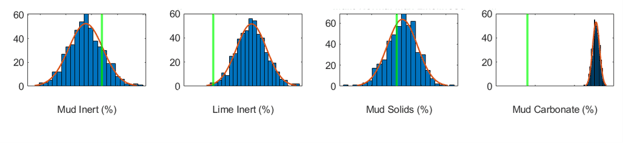
The application of these techniques provides estimates of those measurements in gross error, which in this application are upwards of 5-10% from their measured values. For lime kilns, the application of these measurements are typically used for engineering decisions associated with key design elements (i.e. chains, refractory, etc.) of the kiln. The use of raw data can result in energy inefficient designs resulting in losses in the hundreds of thousands per year, or worse designs associated with shorter refractory life and unexpected downtime ($millions/incident). Data reconciliation is therefore an important first step towards pushing our lime kilns towards energy efficient and reliable operation.
This project has been made possible [in part] by the Natural Resources Canada’s Forest Innovation Program.
For more information contact
Wesley Gilbert, Lead Scientist
wesley.gilbert@fpinnovations.ca


